How to Open and Scale an Authentic Portuguese Restaurant in a Foodie Culture
Operating a high-volume restaurant requires moving beyond 'average' consistency by implementing rigorous manual data loops and cultural symbiosis. Success in international markets depends on balancing rigid culinary authenticity with 20% adjustments for local palate expectations.
The Corporate Fallacy: Why Tech Experience Fails at 6:00 AM
Transitioning from a corporate headquarters like Food Panda to the humid floor of a central kitchen is a violent wake-up call. Many operators believe that understanding “the numbers” or “the apps” provides a strategic advantage. It does not. The spreadsheets used in a Berlin or Mexico City office have zero utility when you are standing at a prep table at sunrise, hands deep in dough, trying to understand why a batch of bread isn’t rising correctly. There is a fundamental disconnect between the “macan space” of food delivery apps and the tactile reality of the “macan space” in a kitchen.
The first hard lesson is that operational knowledge is only gained through observation and physical presence. Managing a team, handling the pace of suppliers, and understanding the logistics of prep work requires a “boots-on-the-ground” apprenticeship. You might have reached what you envisioned in your corporate life, but the restaurant floor does not care about your pedigree. It cares about whether you can manage the “ops” of a small business—specifically, the grueling coordination between back-of-house (BOH) and front-of-house (FOH). If you haven’t lived the 6:00 AM dough-making routine, you cannot lead a team of bakers. You must be willing to do everything, from cleaning tables to course-correcting a junior team on R&D days, before you can claim to “manage” anything.
The Complexity Trap: Scaling from Boutique to High-Volume
There is a massive, often underestimated, jump in complexity when moving from a small neighborhood spot to a large, multi-concept venue. A boutique restaurant in a place like Bangsar might allow you to observe and learn the outline of a business. However, when you open a massive space in a central hub, the complexity doesn’t just double—it increases fourfold. You are no longer just managing a kitchen; you are managing a bakery, a high-volume bar, a brunch service, and a formal dinner service simultaneously.
This level of complexity demands a specialized hierarchy. You cannot be the head chef and the head baker while also running the business side. For an international concept like Portuguese cuisine, this means flying in experts to establish the baseline. Bringing in a chef from Portugal for the first eight to ten months is a technical necessity, not a luxury. This period is a high-stakes training ground for a local team that lacks the innate flavor profile of the cuisine. Once that expert leaves, the owner is left with a junior team that can execute but cannot innovate. This is the “danger zone” for restaurants. You must develop enough technical knowledge to research and test recipes alone on your days off, ensuring that you can settle the standards before handing them to the team for restaurant-scale production.
Cultural Symbiosis and the Gender Authority Gap
Managing a diverse, regional team introduces human variables that no management textbook prepares you for. In many Southeast Asian kitchen cultures, authority is often instinctively granted to male figures, regardless of the official organizational chart. This creates a friction point when your top manager is female. It is not uncommon to see complaints or technical queries bypass a female manager and go straight to a second or third-in-command simply because of gender-based cultural conditioning.
As an operator, you cannot simply “enforce” Western management styles and expect them to stick. The reality is that you have to find a “symbiosis.” You must work within the existing cultural framework to ensure the female leader’s authority is respected while acknowledging the team’s internal dynamics. This isn’t about giving in to discrimination; it’s about tactical leadership. You find a middle ground where the management team works as a unified front, slowly shifting the team’s perception through consistent performance and shared goals. If you don’t address these granular societal values, your floor management will crumble during a high-stress Friday night shift.
The “Average” Death Trap and the Expectation Game
The fastest way for a restaurant to die is to be “average.” Bad restaurants get feedback; people complain on Google, send emails, or tell the waiter. Exceptional restaurants get praise. Average restaurants simply disappear. They become “convenience stops” that people visit only when they have no other options. To avoid this, you must define exactly what you consider “exceptional” and then relentlessly map that against the taste profile of your target demographic.
Consistency is the only hedge against becoming average. In a Portuguese restaurant, this is particularly difficult because the local staff isn’t eating the food at home. You have to create repetitive processes that leave zero room for interpretation. This is where the “expectation game” replaces the “standard game.” You aren’t just trying to hit a culinary standard; you are trying to manage the customer’s expectation of that standard. If you serve 300 people a day, some will inevitably find your “exceptional” dish to be “too crunchy” or “too sweet.” You have to have the conviction to know when to stick to your guns and when to adapt. This requires a baseline of data that most independent owners simply ignore.
Engineering the Data Loop: Paper to WhatsApp Intelligence
While many restaurants ask “how was your food?”, very few make that information actionable. To maintain a competitive edge, you need a high-granularity customer experience (CX) report delivered every single day. This doesn’t require a complex iPad survey that customers hate; it requires training your waitstaff to have “small conversations” that extract data.
Waiters should be tracking specific metrics: Is it the customer’s first time? How did they hear about the restaurant (social media, walk-in, etc.)? What did they leave on the plate? This information is scribbled on a piece of paper the moment the waiter hits the POS system and is then compiled into a daily CX report shared in a company WhatsApp group. If people are leaving the bread on the prawn dish, that is a data point. If first-time customers are outnumbering regulars 2-to-1, that tells you something about your marketing vs. your retention.
For owners who can’t be on the floor 24/7, this data is lifeblood. While tools like QR Menu Maker offer an Insights and Analytics Dashboard to track which items are being viewed most frequently, combining that digital data with the “verbal” data from the floor creates a complete picture of your operations. It allows you to see the “average” customer’s experience before they walk out the door and never come back.
Palate Adaptation: The 20% Rule for Authenticity
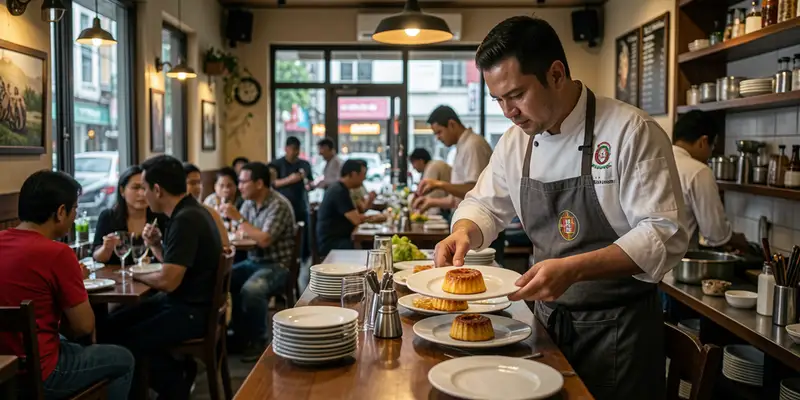
Authenticity is a moving target. You can serve a 100% authentic Portuguese pastel de nata—using pure butter instead of margarine for that specific “rich and crunchy” profile—and still have customers complain it’s “too hard” or “too sweet.” The problem isn’t the recipe; it’s the context. In Portugal, that tart is paired with a bitter espresso. In Malaysia, it might be paired with a sugary latte or a fruit juice. That sugar-on-sugar combination ruins the experience.
The tactical move for an independent owner is to find the “20% adjustment.” By reducing the sugar in the custard by 20%, you maintain the “authenticity” for the Portuguese expats (who often don’t even notice the change) while eliminating the “too sweet” complaints from the local market. This is the difference between being a culinary purist and a successful business owner. You must listen to the raw feedback of the market and be humble enough to realize that “freedom” and “flavor” are expressed differently in different societies.
Surviving the Viral Hype Cycle and TikTok Tourists
In the age of social media, “going viral” can be a curse. You will see “TikTok tourists” who order a table full of food, spend an hour filming it until it’s stone cold, and then take one bite before leaving a review. This behavior is antithetical to the effort put into the kitchen. These customers aren’t there for the food; they are there for the “hype.”
As an operator, your goal is to convert that shallow viral energy into deep, local retention. The hyped places that close within a year are those that couldn’t transition from “trending” to “essential.” You must encourage people to actually try the “weird” dishes—like a bread porridge made with prawn stock (Assorta)—rather than just the familiar items. If your market only eats what is familiar, your innovation will starve. You have to use your FOH warmth and personal touch to guide customers toward a deeper appreciation of the culture, turning a “viral moment” into a long-term relationship.
Scaling the Brand: From Full-Service to Mall Kiosks
Once the main “mother ship” restaurant is stable, the next logical step is spin-offs. Moving into high-traffic areas like Pavilion or BSC with a “kiosk” model focused on a single hero product (like the pastel de nata) allows for a different revenue stream with lower overhead. However, this brings you back to square one: stabilization.
Each new outlet is a fresh set of “ops” challenges. You have to ensure that the “crunch” of the pastry in a mall kiosk matches the “crunch” of the pastry at the central market. This is where real-time menu management becomes critical. If you are running multiple kiosks and the price of imported butter spikes, you need to update your pricing across all locations instantly. Using a platform like QR Menu Maker allows you to push real-time menu updates for prices and item availability across multiple web links and QR codes without reprinting physical materials. This agility is what separates the “silly” operators from the pros who understand that a restaurant is a game of margins, data, and relentless consistency.
{
  "@context": "https://schema.org",
  "@type": "FAQPage",
  "mainEntity": [
    {
      "@type": "Question",
      "name": "How do you handle complaints about 'crunchy' bread in a market that prefers soft textures?",
      "content": "You must understand that this is an 'expectation game.' While you stay true to the authentic recipe (using butter and high-heat browning), you must train FOH staff to explain the texture to customers beforehand. If the complaint persists, evaluate if the pairing (like soup or coffee) is providing enough contrast."
    },
    {
      "@type": "Question",
      "name": "What is the best way to manage gender dynamics in a diverse kitchen team?",
      "content": "Create a 'symbiosis' between leaders. If the team naturally looks to a male figure for authority, use that figure to publicly reinforce the female manager's decisions. Forcing Western hierarchy without acknowledging local cultural values often leads to a total breakdown in communication."
    },
    {
      "@type": "Question",
      "name": "How can a restaurant owner collect actionable data without being on-site 24/7?",
      "content": "Implement a manual paper-to-WhatsApp loop. Waitstaff should record first-time vs. repeat visits and specific dish feedback (e.g., 'prawns left over') on a paper slip at the POS. This is then summarized into a daily CX report. Digital analytics from QR [Menu Maker](/) can supplement this by showing which menu items are viewed most often."
    },
    {
      "@type": "Question",
      "name": "How do you maintain consistency when the kitchen team isn't familiar with the cuisine?",
      "content": "Invest in an expert (e.g., a native chef) for the first 6-10 months of operation to bake the flavor profile into the team's muscle memory. After the expert leaves, the owner must personally lead R&D on 'off-days' to settle recipes before they are rolled out to the junior team."
    }
  ]
}